We’ve been sold a story.
That strength means pushing through.
That real power lies in overriding pain, ignoring fatigue, and proving we can do more, no matter the cost.
This story starts early, especially for boys. We teach them that limits are for the weak. That stopping means you’re soft. That listening to your body is an excuse, and that toughness is defined by how much you can endure.
But here’s the truth:
This version of strength is breaking us down.
It’s disconnecting us from the very system designed to keep us healthy, whole, and human.
The Cost of Disconnection
I was born with physical challenges, so I never had the option to override my limits.
I had to listen to my body from the beginning.
Not because it was trendy or mindful—because it was necessary.
What I learned, through lived experience and clinical work, is this:
Limits don’t make you fragile.
They make you stronger.
But when we don’t listen? When we treat fatigue as weakness and pain as a challenge to beat?
We suffer.
And We Are Suffering.
Our culture glorifies pushing past the edge, but that edge has a breaking point. The consequences are serious. And they’re everywhere.
📉 Let the data speak:
- Chronic stress contributes to six of the top ten causes of death in the U.S.
- It’s linked to heart disease, cancer, diabetes, autoimmune illness, anxiety, depression, and more
- A 2022 Lancet study found that people with high psychological distress had a 40% greater risk of stroke
- The American Institute of Stress reports that stress plays a role in up to 90% of doctor visits
This isn’t just about feeling “off” or “overwhelmed.” This is about real, measurable harm to our bodies and minds.
Before illness sets in, the body tries to speak—through tension, exhaustion, insomnia, brain fog, irritability, or pain. But if we’ve been conditioned to push through?
We miss the early signals.
And often, we don’t stop until the damage is harder to repair.
The Traffic Light Model: A Map for Listening
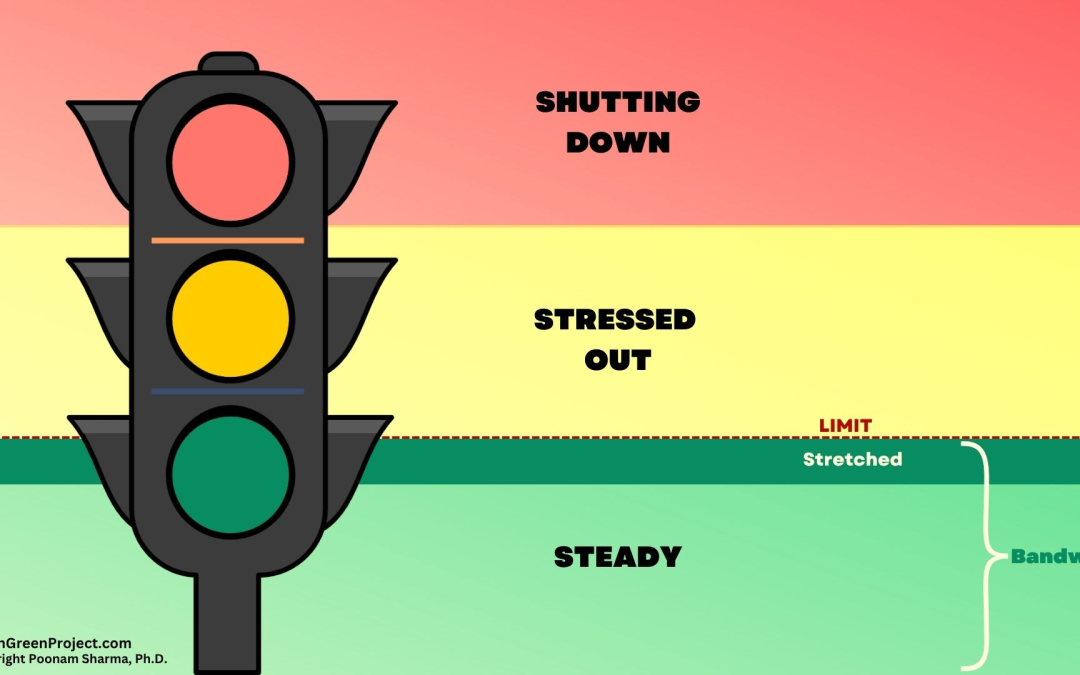
In my work, I use a tool called the Traffic Light Model to help people recognize their nervous system states.
🟢 Green: Calm, grounded, connected
🔼 At the top of Green lies the Stretch Zone—the place where healthy challenge builds capacity
🟡 Yellow: Activated, stressed, anxious, reactive
🔴 Red: Shut down, depleted, withdrawn
This model maps beautifully onto the science:
- Eustress (from psychology) is the kind of challenge that energizes and motivates us
- Hormesis (from biology) refers to small, tolerable doses of stress that actually strengthen the system
But both depend on one thing:
Recovery.
You can only stretch so far before you tip from challenge into collapse.
Stretching strengthens.
Pushing too hard harms.
The Lie of Limitless Strength
We are not machines.
We are sensing, adapting, living beings.
Our strength doesn’t come from bypassing discomfort.
It comes from knowing how to respond to it.
And yet, so many of us are caught in survival mode, trained to override until breakdown becomes inevitable. We’ve internalized the belief that worth comes from productivity, and power comes from pretending we have no limits.
But what if the opposite is true?
What if strength lives in the pause?
In the ability to say, “This is enough for today.”
In the courage to stop before we shatter?
This Is What Strength Really Looks Like
Let’s be clear:
Rest is not weakness.
Recovery is not failure.
Boundaries are not excuses.
True strength is knowing how to stay connected to your body—even when the world tells you to ignore it.
It’s:
- Pacing with intention
- Resting without guilt
- Noticing early signs of overload
- Respecting your own capacity, even when others don’t
- Trusting that limits are not signs of inadequacy; they are guides for growth
Redefining Strength, Reclaiming Health
It’s time to rewrite the script:
- Strength isn’t force—it’s focus.
- Strength isn’t being unbreakable—it’s knowing how to stay whole.
- Strength isn’t how far you push—it’s how well you last.
You don’t become strong by overriding your body.
You become strong by building a relationship with it.
💭 A Question to Reflect On:
What messages did you grow up with about limits—and how have they shaped your relationship with your body?